Scoliosis Brace Manufacturing and Modeling
Found all 6 test markers with no false hits on a real handheld scan of one subject with no known spinal curve. My Python pipeline levels the raw torso scan along the body axis and finds the printed markers by shape, rejecting clothing folds. It then trims and closes the scan into a solid model. The same research builds an Ansys spine model to predict how a brace pad changes the spinal curve.
ToolsPython, Ansys Mechanical APDL, 3D scanning, FEA
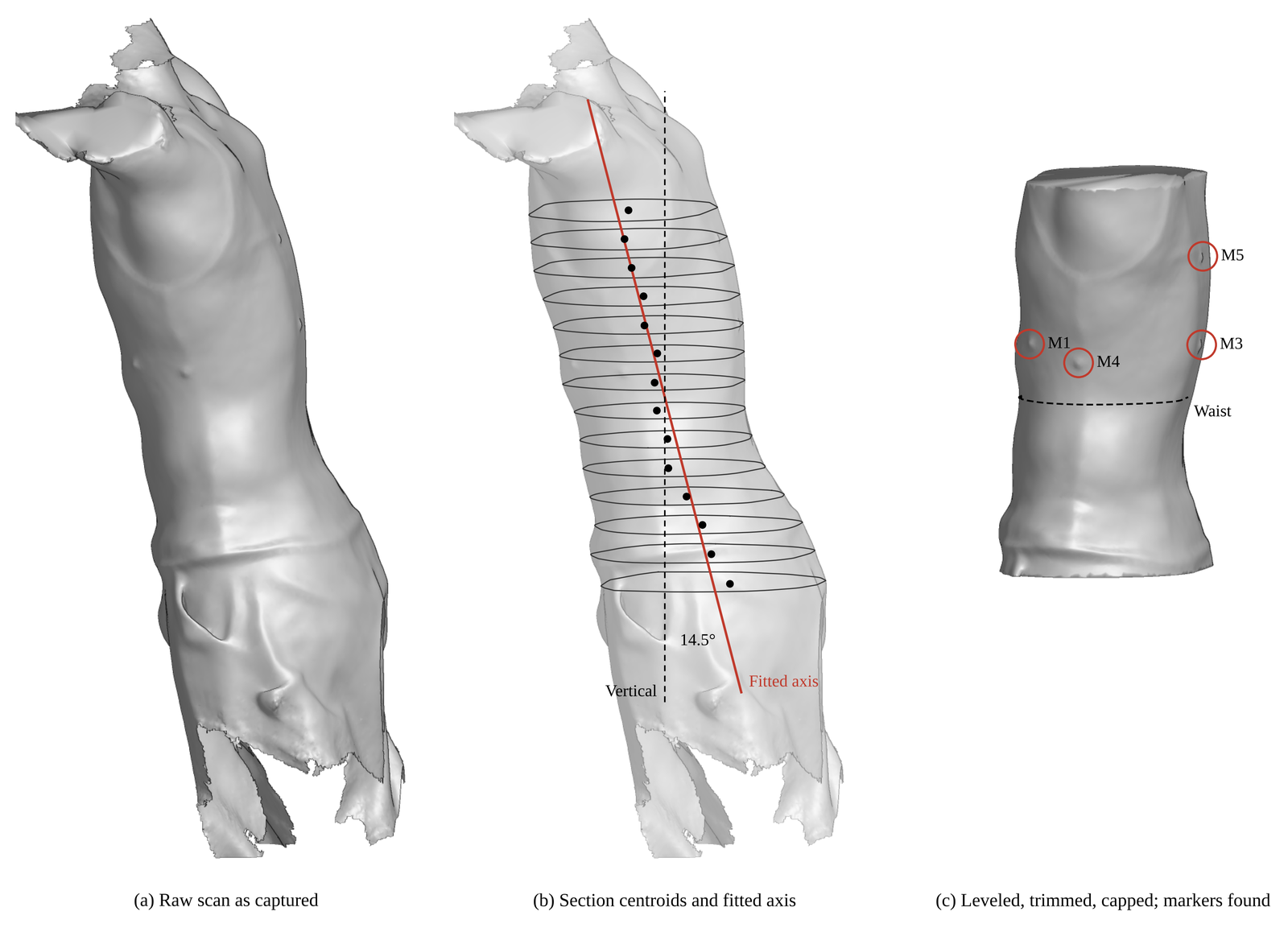
Scan processing
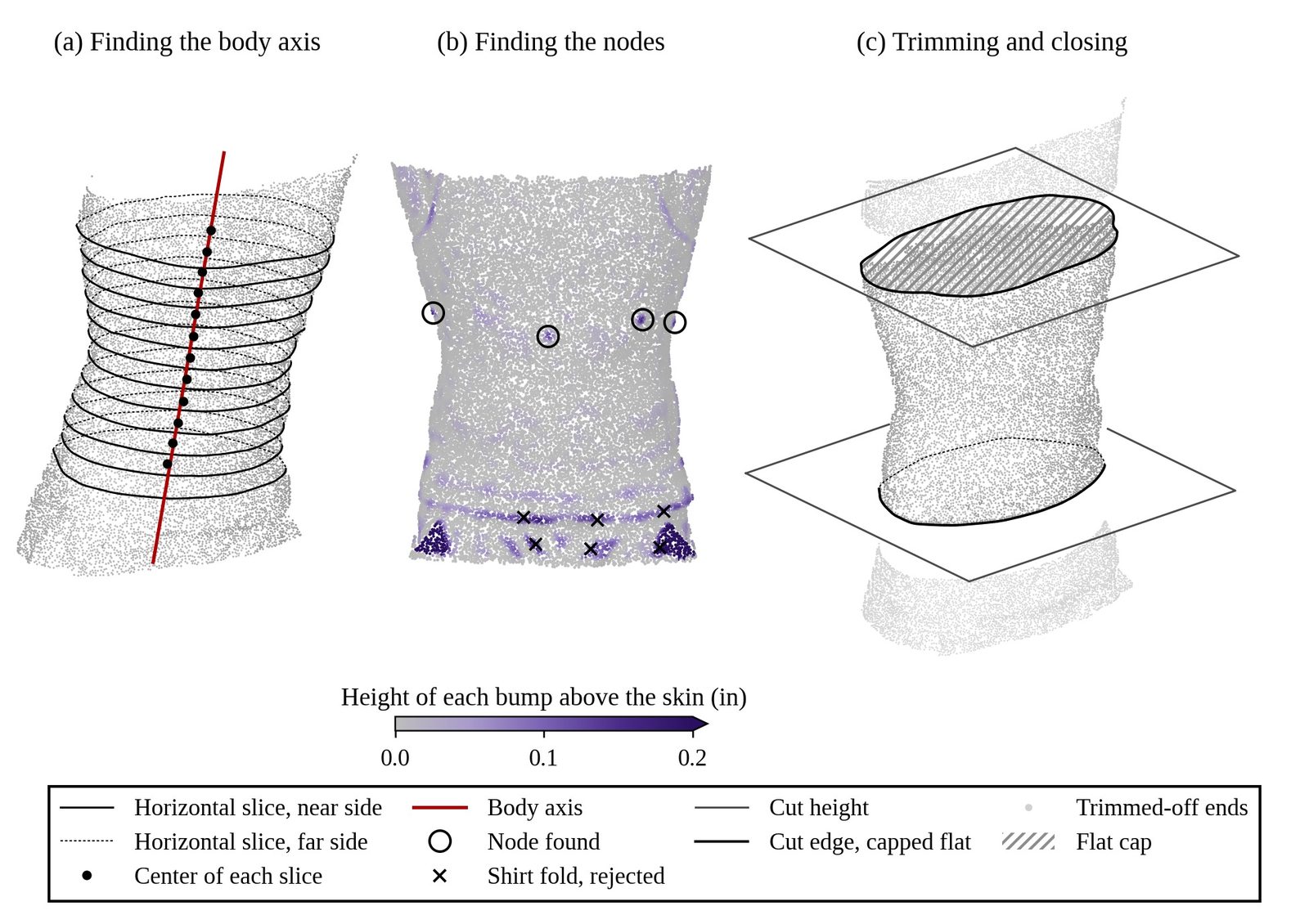
Designed a printable marker strip for future scans.
Spine model
17 stiff cylinders for the vertebrae (L5 to T1) stacked on 17 short soft discs, 20.4 in tall, base fixed. Only disc stiffness is tuned, so every level matches published segment bending stiffness (16.8 in-lbf/deg lumbar).
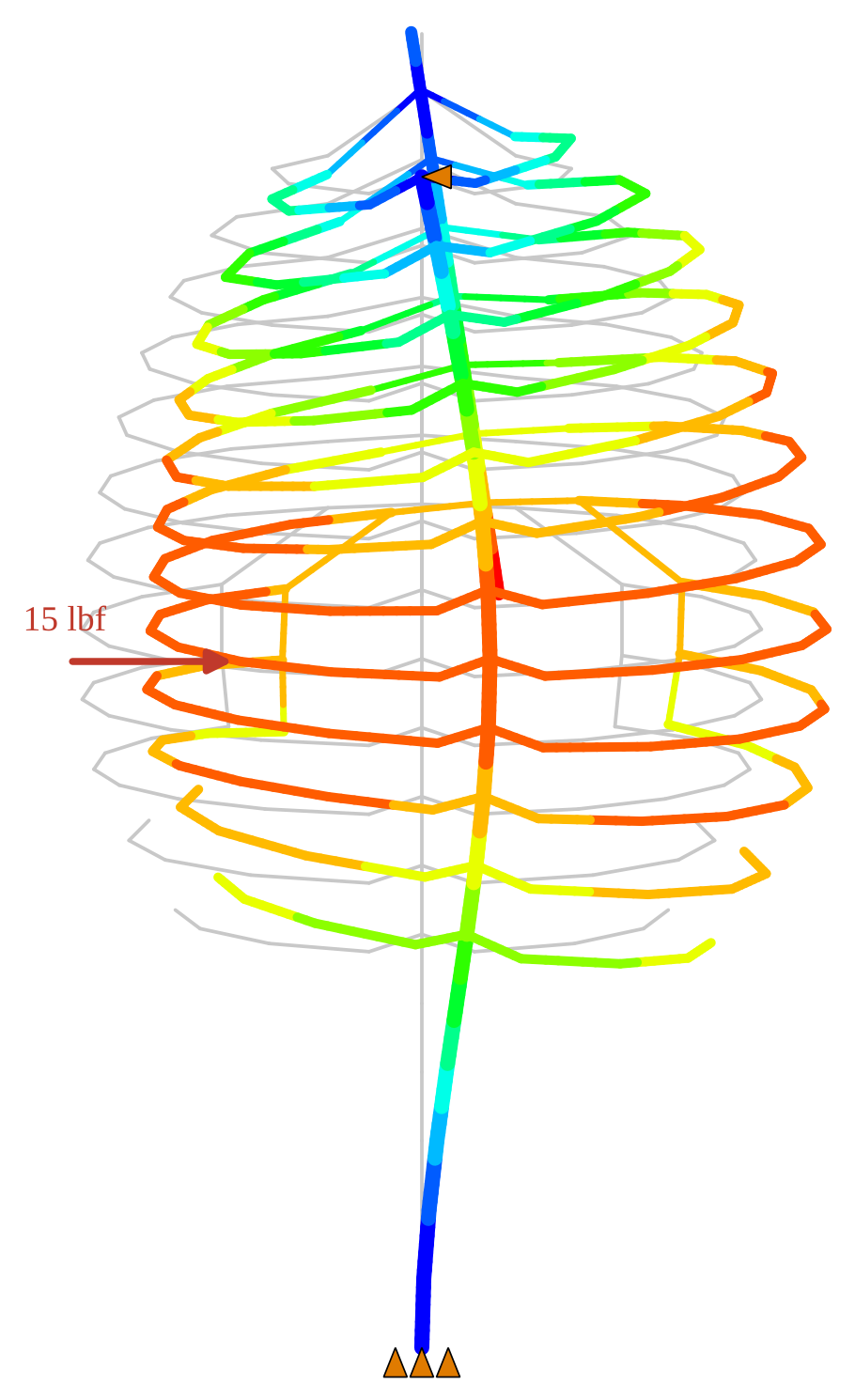
Brace pad: on an assumed 30° thoracic curve, a 15 lbf pad on T7 to T9 reduces the Cobb angle 18.5° in the linear solve. With large deflection the reduction is 13.6°, 27% less. A fixed 0.25 in pad displacement gives the same Cobb change within 1.3% in all three methods I ran (linear solid, beam, large deflection). The next model drives pads by displacement.
Verification and validation
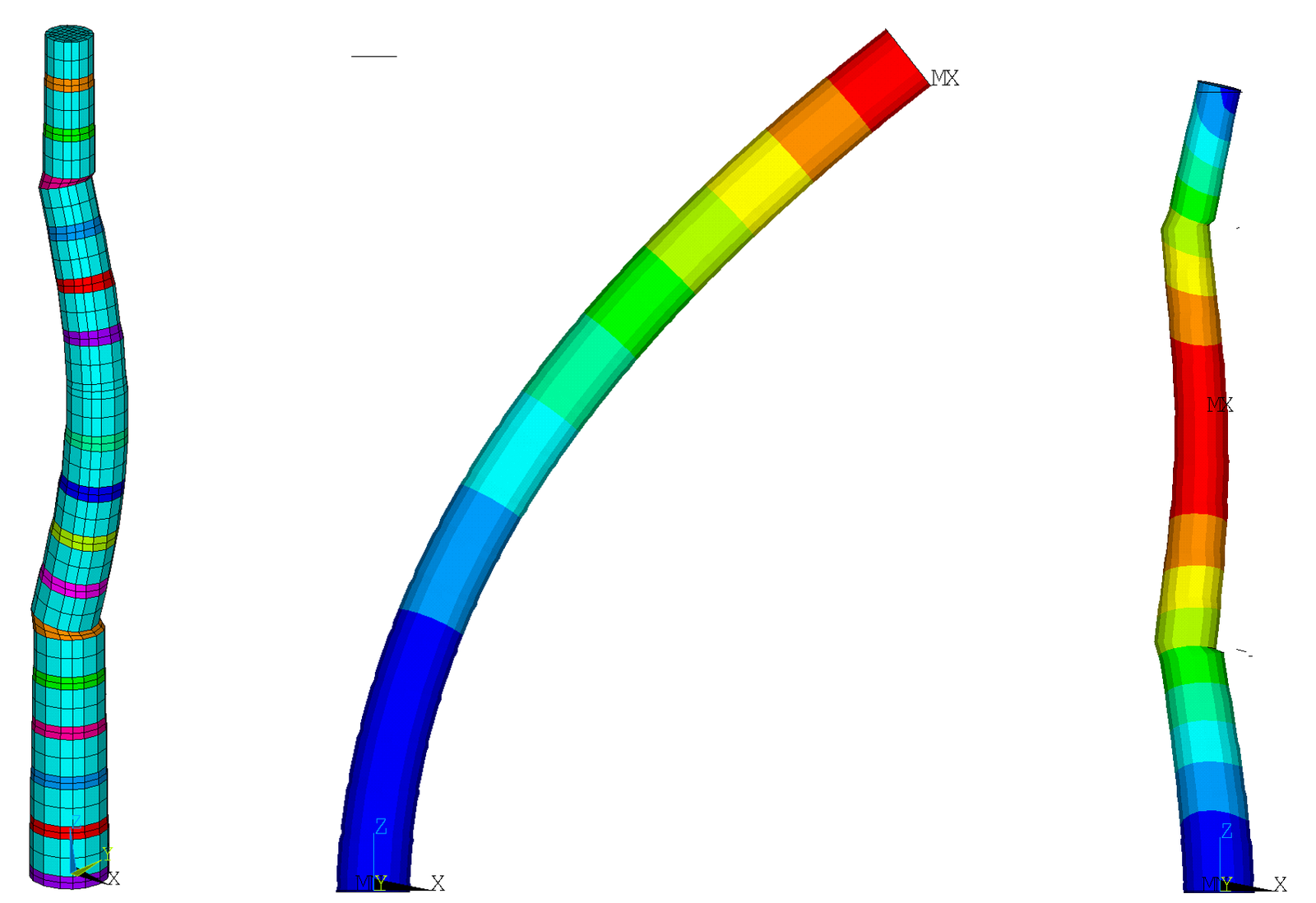
Verification: Ansys matched an independent solve of the identical mesh within 1% on all 13 load cases; refining the mesh changes bending about 1%. This checks the solve only, with no comparison to real spines.
Validation: whole-spine bending lands within 7 to 18% of three published spine-only studies. Twist is 2.4 times too soft and will be tuned with the ribs. Thoracic forward bending is 1.54 times too loose, because a round cylinder bends equally in every direction.
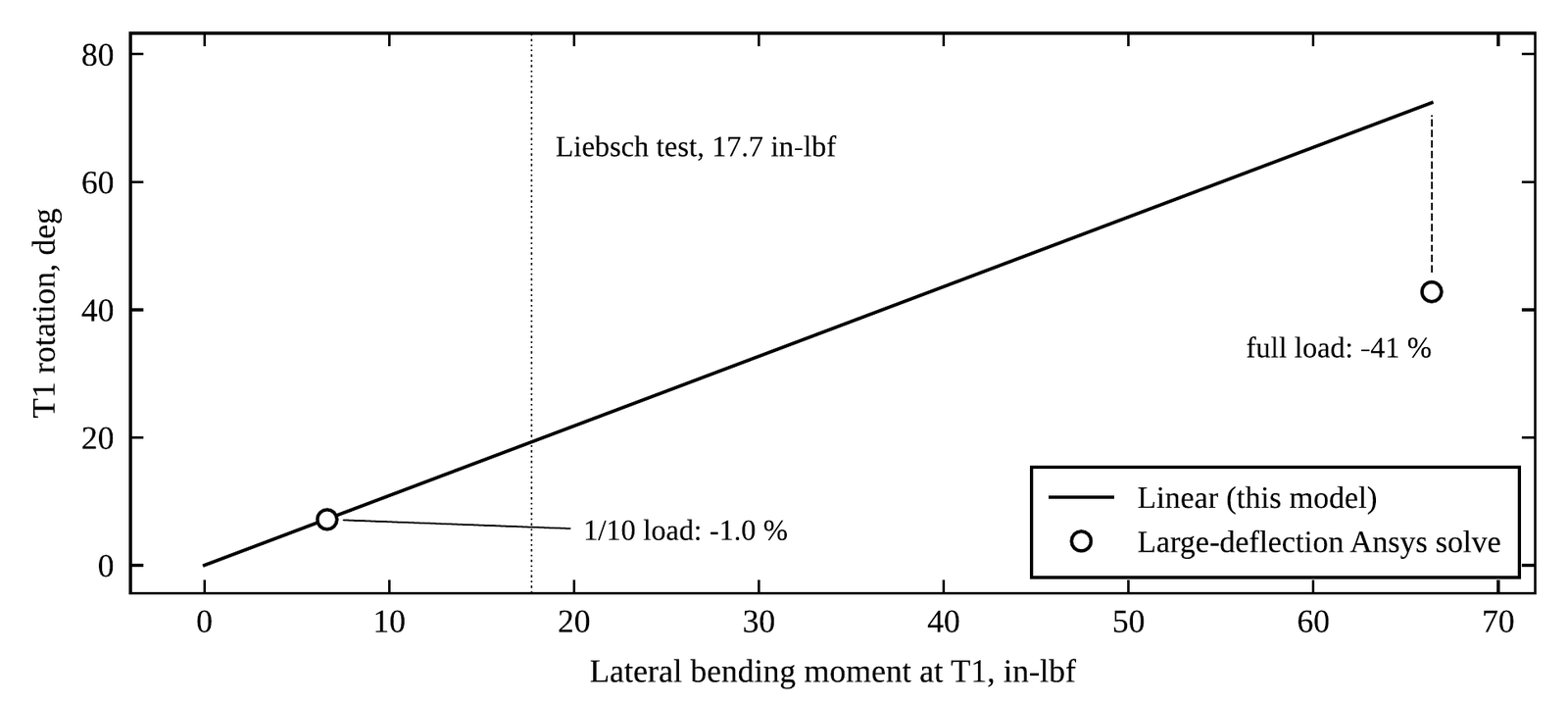
Nonlinear effects: linear and large-deflection solves agree within 1.0% at 1/10 of the 66.4 in-lbf (7.5 N·m) test moment. At full moment, linear overstates rotation by 41%, because the disc edges reach about 21% strain. Under the spine's own weight, large deflection bends the curve 69% further than linear, so gravity cases need it once ribs are in.
Limitations
- No ribs, ligaments, muscles, or preload yet; each stiffens a real spine
- Round, uniform cylinders and assumed geometry; the 30° curve and 15 lbf pad are assumed inputs
- No patient data: nothing is checked against a living spine or an in-brace X-ray yet
Next steps
Add the rib cage, tune twist with it, and drive pads by displacement. Then compare against patients; the usual pass mark is an in-brace Cobb angle within 5° of the X-ray.